


Clamshell containers may share the same basic format, but the details can change how well they work in an operation.
Two packages with similar dimensions can open differently, close differently, merchandise food differently, and require different handling on a production line. A container may be filled, closed, labeled, stocked, carried, opened, and sometimes reclosed before its job is done.
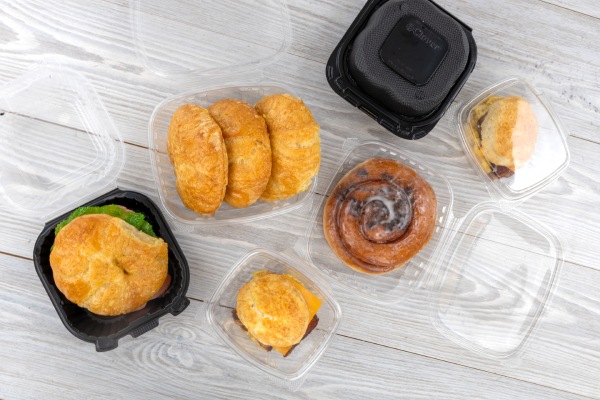
That is where clamshell container design becomes important. The right comparison is not simply size versus size or material versus material. It is how specific design features support the way the package will actually be used.
Easy Opening Is a Real Design Feature
Opening a clamshell should not require a customer to search for a place to grip it.
Commercial designs use features such as offset tabs, textured grip areas, dual opening tabs, and clearly separated lid and base edges to make opening more intuitive. Some closure systems also provide tactile or audible confirmation when the lid has fully engaged.
Those details can matter during service as well as after handoff. Employees may close large numbers of containers during a shift, while customers may need to open the package at a desk, in a vehicle, or somewhere without a traditional dining setup.
Reclosability can matter too. Snacks, bakery items, cold prepared foods, and larger portions may be opened more than once. A design that can be reopened and secured again can remain useful after the first serving.
Small details around grip, opening, and reclosing can therefore make a noticeable difference in everyday use.
The Lid Can Change What Happens After Handoff
A hinged lid is useful because it stays attached to the base, but some clamshells are designed to give the customer another option.
Perforated or tear-away lids can be removed after the food reaches its destination. That can allow the base to function more like a serving dish and reduce the need to transfer food to another plate.
Lid profile matters as well. A flatter design may work well for compact foods and efficient displays, while a higher dome can provide additional clearance for sandwiches, bakery products, or taller portions.
The lid is therefore more than a cover. Its shape and opening behavior can influence how the package is handled and how the customer ultimately eats from it.
Retail Packaging Has to Work on the Shelf
Restaurant takeout is usually packed after an order is placed. Retail and grab-and-go packaging may need to perform before the customer has even selected the food.
That changes the design priorities.
Clarity can help keep the food visible. Footprint affects how efficiently products use limited display space. Lid profile influences presentation, while grip areas affect how easily shoppers can pick up and inspect the package.
For cold prepared foods, AD Deli clear hinged containers illustrate how transparency, different depths, and high-dome options can support refrigerated grab-and-go presentation without changing the basic clamshell format.
A package designed primarily for counter handoff may not need to accomplish the same things. In a retail environment, merchandising becomes part of the package’s job.
Labeling Should Be Considered Early
Labels are easy to treat as a separate step, but the container itself can affect how easily they are applied.
Retail and prepared-food programs may need space for product names, ingredients, pricing, nutrition information, dates, barcodes, or branding.
Wide, flat panels and smooth lid surfaces can make label positioning easier, while labels should remain clear of opening tabs.
High-volume operations add another requirement: consistent package orientation. If labels are applied mechanically, containers need to reach the labeling point predictably so information can be placed in the same location from package to package.
That makes label compatibility part of the packaging decision rather than something to solve after a container has already been chosen.
High-Volume Packing Changes the Design Brief
The customer sees one finished clamshell. A commissary, prepared-food processor, or large grocery operation may see thousands of empty packages moving through production.
At higher volumes, containers may be separated from stacks, conveyed, closed, and labeled with equipment. Some commercial clamshell systems are specifically designed to work with processes such as:
- de-nesting stacked containers
- automated closing
- conveyor handling
- label application
- consistent package orientation
This creates a different design question from ordinary manual packing.
A container can work well when handled individually and still be a poor fit for a production line. At lower volumes, an employee may compensate for a package that requires an extra adjustment. When thousands of units move through the same process, small handling differences can become meaningful operational issues.
The package therefore needs to fit the workflow as well as the food.
Compare the Features That Affect Your Workflow
A useful clamshell comparison goes beyond dimensions, material, and case count.
| Design feature | What to consider |
|---|---|
| Opening tabs | Is the package easy to grip and open? |
| Reclosability | Will customers open the container more than once? |
| Lid profile | Does the food need a flat, domed, or removable lid? |
| Merchandising | Does the package need to display food before purchase? |
| Label area | Is there enough usable space for required information? |
| Automation fit | Will the package be denested, closed, conveyed, or labeled mechanically? |
Thinking about clamshell container design this way keeps the decision tied to the operation instead of turning it into a generic feature checklist.
Design for the Way the Package Will Actually Be Used
Not all clamshells are equal because not all operations ask the package to do the same job.
A restaurant may care most about fast handling and easy customer opening. A bakery or deli may need clear presentation and the right lid profile. A grab-and-go program may place greater emphasis on labeling, while a high-volume commissary may need packaging that works reliably with production equipment.
Those differences are what make design details worth comparing.
The stronger choice is not automatically the package with the longest specification sheet. It is the one designed around what needs to happen from packing and merchandising through handoff and final use.
Explore hinged container options to compare available formats and configurations, or request a sales call to evaluate packaging for a specific foodservice application.